
AI assisted editorial. Published following automated quality checks, not independent fact verification. Confirm factual, safety and legal matters with appropriate professionals.
The short answer
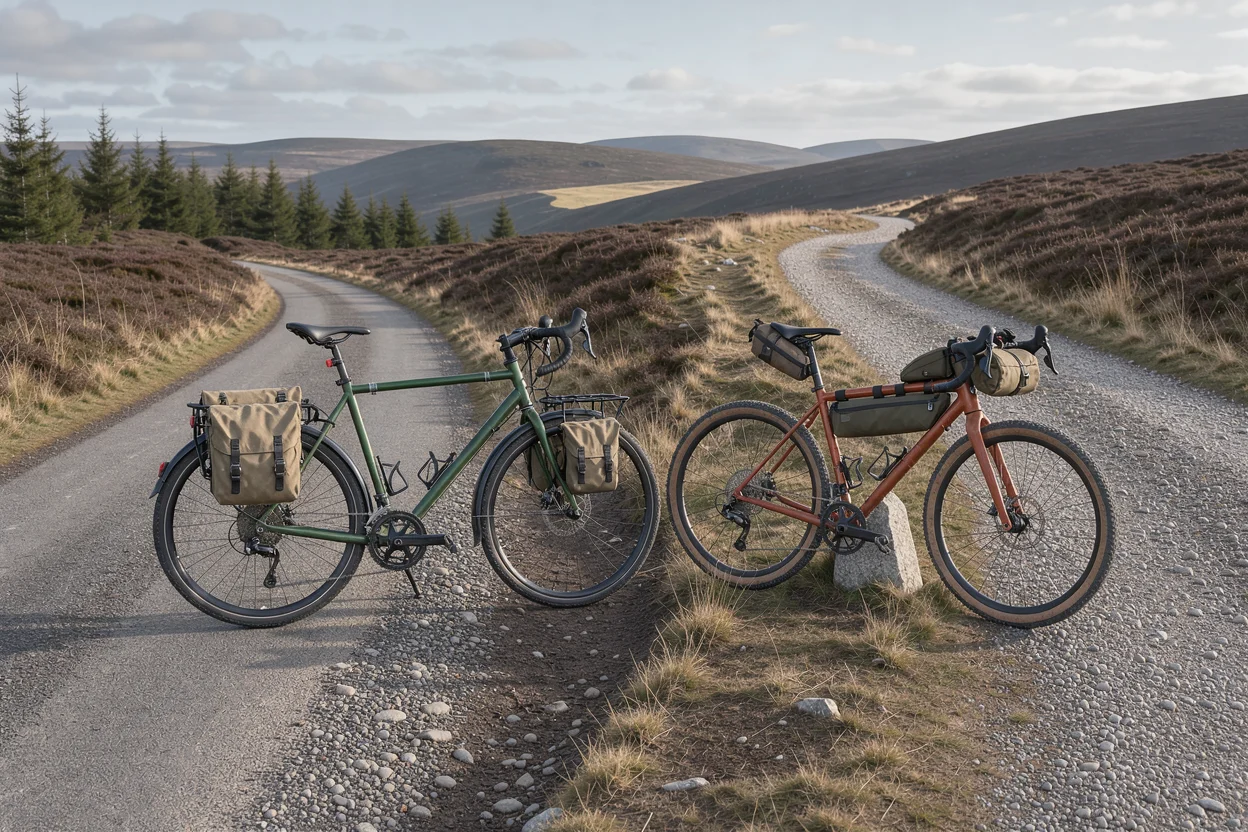
Touring bikes offer stability and hefty load bearing capabilities on tarmac and smooth tracks, whereas gravel bikes provide lighter frames, modern off road clearance, and spirited handling over variable terrain. Choosing between them comes down to luggage payload, surface roughness, and preferred riding posture over consecutive days in the saddle.
Key takeaways
- Touring bikes prioritise long wheelbases, heavy load rack mounts, and upright comfort over paved surfaces or graded roads.
- Gravel bikes feature broader tyre clearances and nimble geometries suited to dirt tracks, forest trails, and lightweight bikepacking bags.
- Luggage strategy dictates frame choice: high capacity panniers demand dedicated eyelets, while soft roll bags suit lighter gravel frames.
- Cockpit ergonomics and gearing ranges must be evaluated together against your intended daily climbing and total cargo weight.
Understanding the Core Architectural Differences
At first glance, a traditional touring bicycle and a contemporary gravel bicycle appear to occupy overlapping ground. Both commonly utilise drop handlebars, multiple gear ratios, and rigid frames engineered to absorb countless hours on the road. Beneath the surface, however, their geometries and intended weight distributions diverge significantly.
Traditional touring bikes are built around extended wheelbases, long chainstays, and relaxed head tube angles. This stretched geometry provides immense directional stability, ensuring that the machine tracks straight even when loaded with heavy front and rear panniers. The longer chainstays also prevent your heels from striking rear bags during pedalling. These frames are frequently fabricated from robust chromoly steel or stiff aluminium tubing designed not to flex excessively under substantial cargo.
Conversely, gravel bikes originate from racing and mixed terrain explorations. Their wheelbases tend to be noticeably shorter, providing snappier acceleration, responsive steering, and greater manoeuvrability when navigating ruts, exposed tree roots, or loose scree. While many gravel frames incorporate endurance oriented geometry, they generally place the rider in a slightly more aggressive, wind cheating position compared to the upright posture of a classic tourer.
Luggage Capacity and Carrying Philosophy
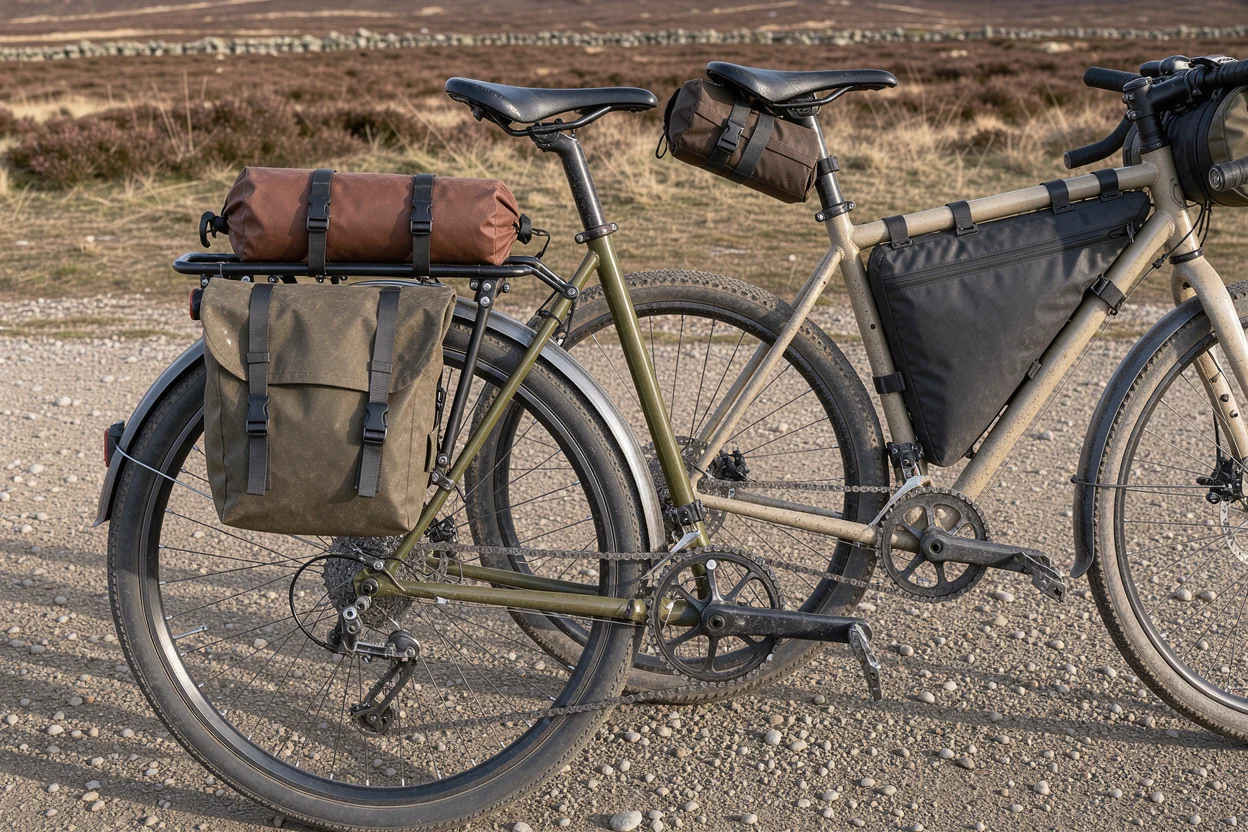
How you intend to carry gear is often the definitive factor between these two styles. Touring bikes are fundamentally designed to accommodate structural pannier racks. They feature reinforced threaded braze ons on the seatstays, dropouts, and fork blades, allowing the direct mounting of sturdy metal racks capable of supporting heavy four pannier systems alongside dry bags mounted atop the rear platform.
Gravel bikes, by comparison, are typically optimised for soft bikepacking luggage, including frame packs, seat packs, and handlebar rolls. While an increasing number of adventure oriented gravel frames now feature fork bottle mounts and discreet rack eyelets, their structural weight limits are generally lower. Attempting to bolt heavy touring panniers to an ultralight carbon or thin walled aluminium gravel frame can compromise handling dynamics and place undue stress on threaded inserts.
If your journey necessitates hauling autonomous camping gear, multi day rations, and bulky cooking equipment across remote regions, the dedicated load ratings of a touring platform offer distinct peace of mind. Conversely, if you prefer lightweight, minimalist bivvy adventures where speed and terrain versatility are paramount, a gravel setup avoids the dead weight of heavy racks.
Terrain Capability, Wheelsets, and Tyre Clearance
Tyre clearance defines where each machine can realistically venture. Classic touring bicycles were traditionally conceived around standard 700c wheels wearing moderately wide touring tyres, typically ranging between 32mm and 42mm in width. These tyres feature thick tread belts engineered to resist punctures from road debris, wire, and flint, but they can struggle for grip and cushioning on loose gravel, sand, or rocky farm tracks.
Gravel bikes have revolutionised all road riding by making generous tyre clearance a core design element. Most modern gravel frames readily accept tyres measuring between 40mm and 50mm, with some compatible with 650b wheelsets accommodating high volume tyres approaching mountain bike dimensions. This additional air volume allows riders to run lower tyre pressures, dramatically reducing fatigue over washboard surfaces and delivering reliable traction on loose climbs.
Wheel construction also reflects these distinct purposes. Heavy touring wheels usually feature high spoke counts (often 36 spokes per wheel) laced to robust, heavy duty rims to prevent spoke failure under high combined loads. Gravel wheelsets focus more on compliant lateral stiffness and lower rotational mass, which assists in keeping momentum over technical climbs but may require closer monitoring when pushed near maximum weight thresholds.
A Practical Comparison Framework
To evaluate which platform best aligns with your journey, consider how your priorities balance across five practical dimensions: Total Payload, Surface Profile, Daily Riding Pace, Ergonomic Posture, and Adaptability.
Under Total Payload, give the advantage to touring bikes if your gear, water, and food routinely exceed twenty kilograms. In terms of Surface Profile, award points to the gravel bike if more than a third of your intended route traverses broken trails, unsealed forestry tracks, or uneven bridleways. For Daily Riding Pace, the lighter chassis and efficient stance of a gravel bike will reward riders aiming for faster average speeds over distance.
For Ergonomic Posture, touring bikes typically favour taller head tubes and upright comfort, reducing shoulder and lumbar tension during twelve hour days. Finally, evaluate Adaptability: a gravel bike sheds its soft bags in seconds to become a lively Sunday club bike or commuter, whereas an empty classic steel touring bike can feel somewhat sluggish on brisk unladen weekend rides.
Essential Questions to Put to Bike Shops and Sellers
When inspecting potential bicycles or consulting with showroom staff, asking targeted questions will reveal whether a model truly meets your expedition demands. Begin by inquiring about the certified total system weight limit. This figure comprises the rider, the bicycle itself, and all mounted cargo; never assume a frame can handle expedition weight simply because it has eyelets.
Next, clarify the actual tyre clearance with mudguards installed. A frame advertised with clearance for 45mm tyres might only accommodate a 38mm tyre once full coverage touring mudguards are mounted. Inquire also about the drivetrain ratios: ensure the lowest gear provides a true sub one to one climbing ratio, which is critical when hauling luggage up steep mountain passes.
Ask specifically about mounting point weight ratings. Frame manufacturers often place strict weight limits sometimes as low as a few kilograms on carbon fork triple boss eyelets, which will rule out heavy fork mounted cages. Finally, check whether replacement spokes, derailleur hangers, and proprietary headset bearings are widely obtainable in the regions where you intend to cycle.
Hypothetical Decision Example: Two Long Distance Riders
To visualise how these tradeoffs operate in real world planning, consider this hypothetical scenario contrasting two prospective adventure cyclists: Rider A and Rider B.
Hypothetical Rider A is organising a three month self supported crossing of paved European routes and canal towpaths. They plan to carry a traditional four season tent, cooking equipment, substantial clothing for varied weather, and office essentials for remote working. For Rider A, a steel touring bike is the logical match. The long wheelbase prevents luggage induced wobble, the heavy duty rear rack reliably supports thirty kilograms of panniers, and the upright riding posture minimises physical strain over consecutive eight hour riding days.
Hypothetical Rider B is tackling a two week fast packing route through the Scottish Highlands, following military roads, rough forestry access paths, and occasional singletrack. Their gear is ultralight, packed into a frame bag, seat pack, and handlebar harness. For Rider B, a gravel bike is clearly superior. The generous clearance for wide, low pressure tyres provides necessary traction over slippery stone, the lighter front end allows them to lift the bike over gates, and the nimble handling makes negotiating rocky descents enjoyable rather than harrowing.
Common questions
Can a modern gravel bike handle traditional four pannier touring racks?
Most gravel bikes are not engineered for four heavy panniers. While some gravel frames feature rear rack eyelets, their forks frequently have lower load limits, and short chainstays can cause your heels to strike large rear panniers while pedalling.
Which bike geometry is kinder to the neck and back on multi week tours?
Touring bikes generally offer a taller stack height, shorter reach, and more upright riding posture that relieves tension from the lower back and neck during consecutive full day rides. Gravel geometry is often lower and longer for aerodynamic efficiency.
Does a dedicated touring bike hold up adequately on rough forest trails?
A touring bike can manage graded gravel tracks, but its narrower tyre clearance, rigid frame, and longer wheelbase make it harsher and harder to manoeuvre over rocky trails, deep gravel, exposed tree roots, and technical off road descents.
What should I check regarding wheel spoke count and rim durability?
For self supported touring with heavy gear, thirty six spoke wheels provide structural redundancy against broken spokes. Gravel wheelsets often use twenty four or twenty eight spokes to save weight, which is fine for lighter bikepacking but riskier under heavy cargo.