
AI assisted editorial. Published following automated quality checks, not independent fact verification. Confirm factual, safety and legal matters with appropriate professionals.
The short answer
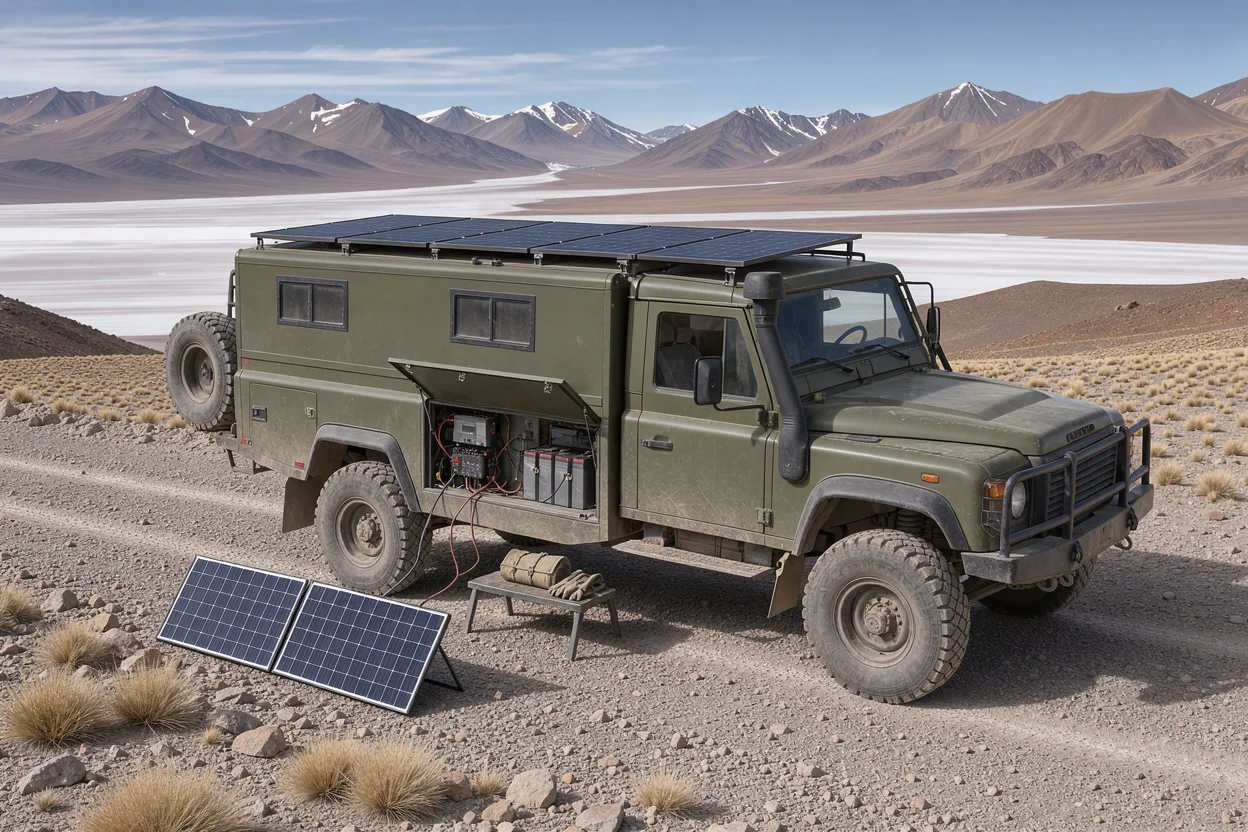
Selecting solar panels and auxiliary batteries for an expedition vehicle requires balancing your anticipated daily power consumption against space, payload limits, and environmental extremes. Success depends on treating generation, storage, and charging control as a cohesive system rather than pursuing maximum headline wattage.
Key takeaways
- Size your battery bank according to usable capacity rather than total rated capacity to protect longevity.
- Account for real world environmental derating, as ambient heat and partial shading significantly reduce solar yields.
- Evaluate system integration, verifying that solar controllers, alternators, and mains chargers match your battery chemistry.
- Scrutinise payload implications, balancing the weight savings of advanced storage against physical protection and thermal limits.
Understanding Energy Generation and Usable Storage
Equipping an expedition vehicle for sustained off grid travel begins with a realistic energy audit rather than a wish list of high powered appliances. Many prospective buyers focus entirely on the peak wattage of roof mounted solar panels, overlooking the reality that nominal output is only achieved under laboratory conditions. Solar harvesting is inherently variable, constrained by sun angle, atmospheric dust, cloud cover, and seasonal shifts. In temperate or northern latitudes, solar collection drops markedly in winter, whereas equatorial travel introduces severe thermal derating, where excessive surface heat reduces panel efficiency.
Equally critical is the distinction between gross storage capacity and usable capacity. A battery rating indicates total stored chemical energy, but drawing down that reserve fully will rapidly degrade or destroy certain chemistries. Reliable off grid autonomy depends on calculating the energy required across twenty four hours of stationary living, factoring in baseline loads such as refrigeration, water pumps, ventilation fans, communication gear, and cabin lighting, then matching that figure against a bank that can deliver the necessary watt hours safely day after day.
Overland travel frequently introduces consecutive overcast days, forest canopies, or urban layovers where solar generation is negligible. Consequently, off grid resilience requires multiple charging pathways. A robust vehicle setup treats solar as a primary maintainer and supplementary source, supported by alternator based charging via dedicated DC to DC converters when driving, as well as an integrated shore power charger for occasional mains connection.
Battery Chemistry Tradeoffs: Lead Acid Versus Lithium
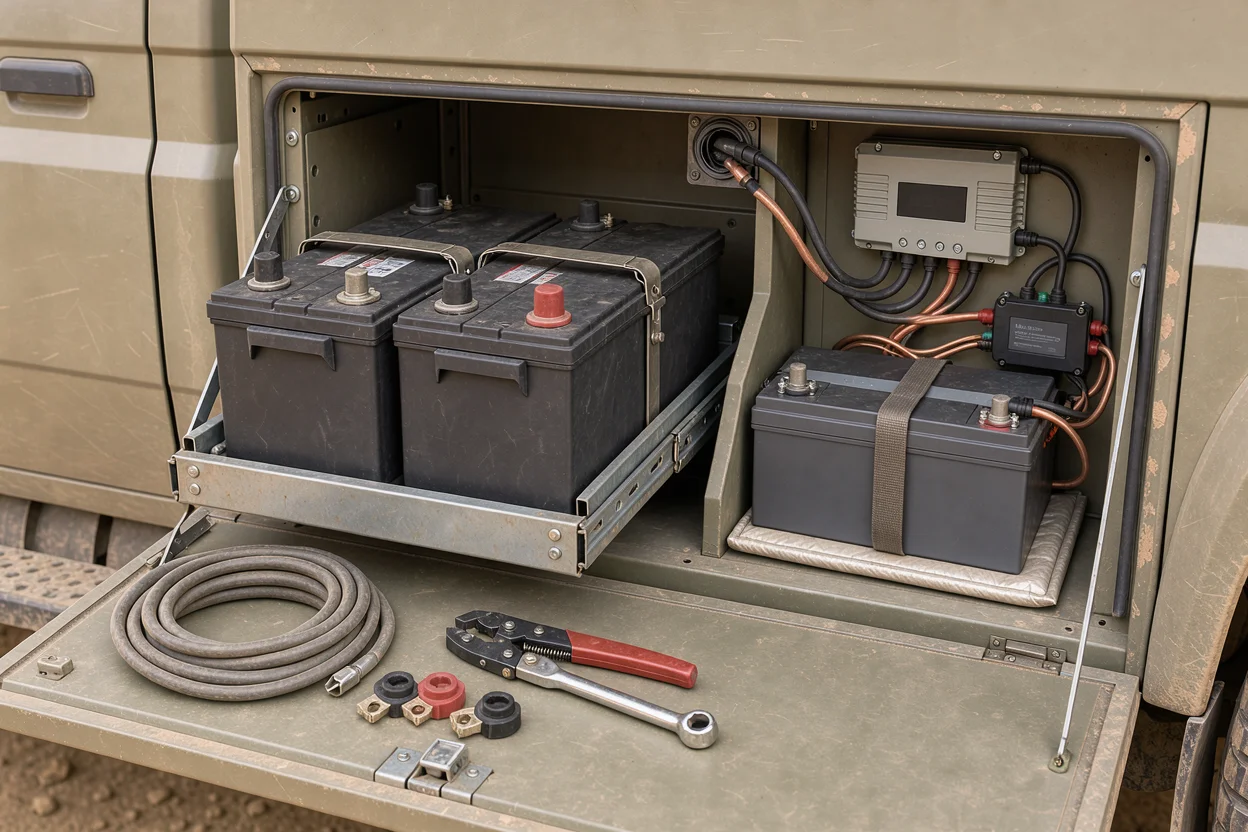
Auxiliary storage in adventure vehicles typically centres on either sealed lead based batteries, such as Absorbed Glass Mat (AGM) and gel cells, or lithium iron phosphate (LiFePO4) variants. Each chemistry carries distinct operational advantages and operational penalties that directly affect vehicle balance, interior living space, and long term running reliability.
Traditional AGM batteries remain attractive for their lower initial purchase price, widespread global availability, and predictable behaviour across a broad temperature range. They can be safely charged in sub zero conditions without complex management electronics. However, AGM technology imposes substantial weight penalties and requires significant bulk for a given energy return. Because regular discharges beyond fifty percent of total capacity shorten an AGM bank's lifespan, users must install twice their calculated daily requirement to maintain longevity. Furthermore, lead acid chemistries exhibit a slow absorption phase, meaning the final twenty percent of charging takes extended time, which is inefficient when relying on limited daily peak sunshine.
Conversely, lithium iron phosphate batteries offer vastly superior usable depth of discharge, often tolerating eighty percent or deeper draws without precipitous degradation. They accept high charge currents right up to capacity, allowing rapid replenishment from high output alternators or brief solar peaks. They also reduce physical weight substantially, preserving critical vehicle gross payload margins. The tradeoffs involve higher initial acquisition costs, greater system complexity, and strict environmental limits. Standard LiFePO4 cells cannot safely accept charge below freezing temperatures without integrated heating elements, and they require active battery management systems (BMS) to guard against cell imbalance, over voltage, and short circuits.
Solar Panel Architecture, Mounting, and Shading Constraints
Solar options for expedition vehicles broadly fall into rigid glass fronted panels and semi flexible modules. Rigid monocrystalline panels mounted in aluminium frames offer the highest durability, excellent resistance to environmental abrasion, and long service life. Crucially, rigid panels mounted on roof brackets retain an air gap underneath, which facilitates airflow and dissipates heat, sustaining higher conversion efficiency during hot weather.
Semi flexible panels appeal to converters seeking minimal aerodynamic drag, low roof profile, and minimal weight. They can be bonded directly to curved pop tops or composite camper shells. However, direct bonding prevents underside ventilation, resulting in higher operating temperatures that impair electrical yield. They are also more vulnerable to surface scratches from low hanging branches and can suffer internal micro fractures if walked upon or subjected to continuous substrate flex.
Panel configuration is equally pivotal. Wiring panels in series raises system voltage, allowing solar charge controllers to begin harvesting earlier in the morning and reducing wire gauge requirements. However, in a series string, partial shading on a single panel from a roof rack, recovery board, or tree branch can suppress the output of the entire array. Parallel wiring isolates shading losses to individual panels but demands thicker cabling to handle higher currents. A balanced compromise often employs multiple maximum power point tracking (MPPT) controllers or split arrays to isolate shaded zones.
Practical Comparison Framework for Electrical Upgrades
When evaluating a bespoke build or an existing pre owned expedition vehicle, use this structured comparison framework to assess whether the electrical architecture suits your operational environment:
1. Usable Energy to Weight Ratio: Compare the net usable kilowatt hours against the total mass of the battery bank and mounting brackets. If vehicle payload is close to legal gross limits, lithium provides an immediate advantage despite higher upfront outlay.
2. Thermal Resilience: Determine the lowest and highest temperatures expected during your journeys. For sub zero winter expeditions, lead acid or heated lithium enclosures are essential. For desert travel, prioritise rigid panels with convective air gaps and well ventilated battery compartments.
3. System Redundancy and Simplicity: Assess whether the system relies on proprietary integrated all in one boxes or modular, off the shelf components. Modular systems permit easier diagnostics and field replacement using standard parts when travelling through remote regions.
4. Replenishment Diversity: Check that the setup incorporates at least two robust charging sources apart from solar, verifying that the DC to DC alternator charging rate matches the battery chemistry's recommended intake without overloading the vehicle's primary starting circuit.
Critical Questions to Put to Vehicle Builders and Sellers
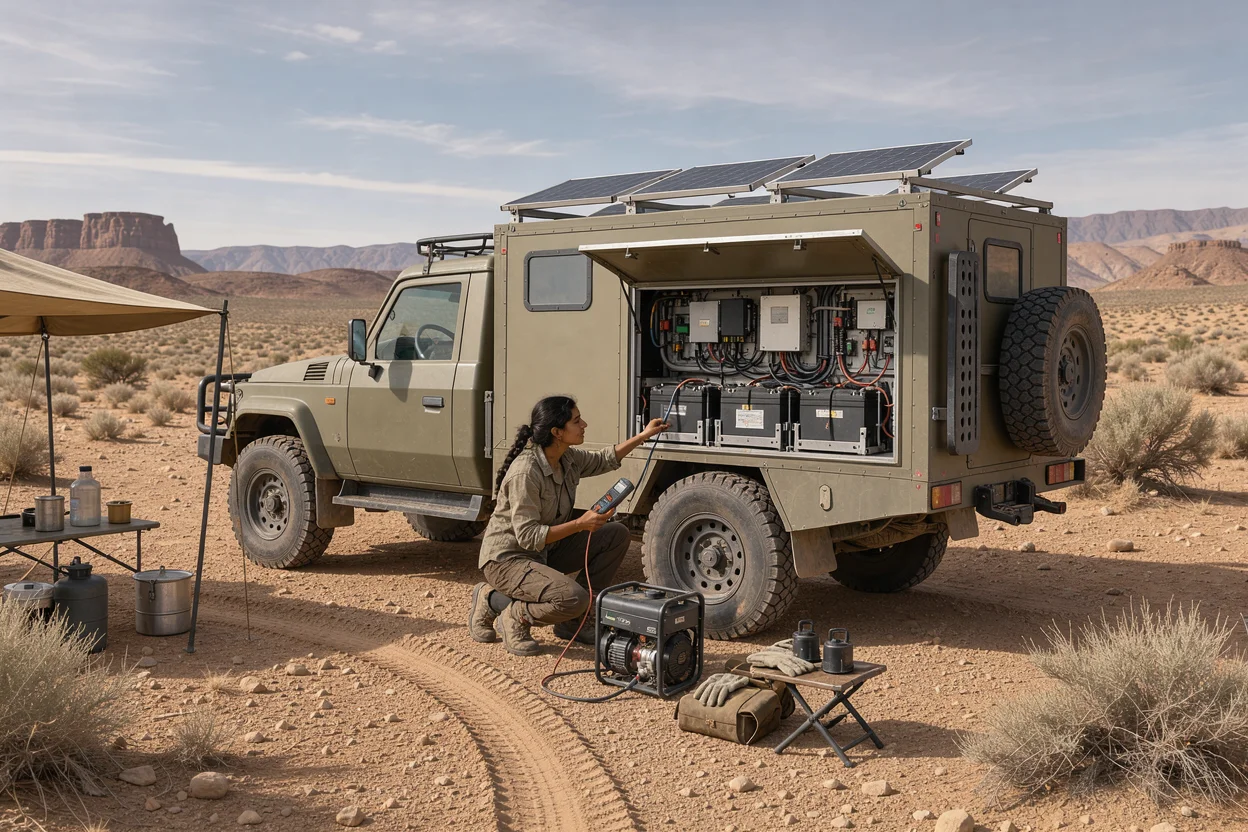
When inspecting a vehicle or discussing an electrical specification with a custom fabricator, asking specific, probing questions will reveal the competence of the installation:
• What is the continuous usable capacity of the battery bank, and at what specific depth of discharge was that calculated?
• How does the solar controller interact with the vehicle alternator charger, and are all charging profiles matched to the battery manufacturer's parameters?
• Is the lithium battery system equipped with internal heating elements, or is there an automatic low temperature charge disconnect managed by the BMS?
• What wire gauge and over current protection have been installed between the solar array, the charge controller, and the distribution busbar?
• How is partial shading handled across the array: are panels wired in series, parallel, or split into independent MPPT channels?
• Can individual components be isolated for troubleshooting without cutting power to essential safety circuits like fridge monitoring or water management?
Hypothetical Decision Example: Remote Touring Versus Shaded Woodland
To illustrate the practical tradeoffs between these systems, consider this hypothetical decision example contrasting two different expedition vehicle requirements.
Profile A represents an overland rig intended for arid, open terrain with long driving stages and open camping in high sunshine environments. In this scenario, the builder selects a 200Ah LiFePO4 battery paired with 300 watts of rigid roof mounted monocrystalline panels wired to a single MPPT controller, supplemented by a 30A DC to DC alternator charger. Because sunshine is dependable and driving intervals are regular, this setup minimises roof clutter and payload weight while providing swift charging and sufficient power for refrigeration and small induction cooking.
Profile B represents a vehicle built for northern wilderness and forested tracks, where dense tree cover limits solar harvest and vehicles remain stationary for four to five days at a time. Here, relying solely on roof solar would result in flat batteries within two days. The appropriate strategy shifts to an expanded 400Ah heated lithium bank or heavy duty deep cycle AGM bank with low parasitic drain, combined with a dedicated ground deployable solar panel on an extension lead to capture light beyond the tree canopy, and an uprated alternator charging system to aggressively replenish the bank during driving segments.
Common questions
Can I mix different battery types or capacities in the same auxiliary bank?
No. Combining different chemistries, ages, or capacities in a single bank leads to uneven charging, premature cell failure, and potential safety hazards, as different batteries demand distinct charging voltages and internal resistance characteristics.
Why does my solar array produce significantly less power than its rated wattage?
Panel ratings reflect standard test conditions of bright, direct light at twenty five degrees Celsius. In the field, panel heating, imperfect sun angles, dust accumulation, wire resistance, and slight shading from roof gear inevitably diminish real world output.
Do I need a DC to DC charger if my vehicle already has an alternator?
Modern vehicles with smart alternators adjust voltage for emissions, preventing proper secondary battery charging. A DC to DC charger ensures the auxiliary bank receives the correct multi stage charging profile while preventing starting battery drain.
What happens if a lithium battery is charged below freezing temperatures?
Charging a standard lithium iron phosphate cell below zero degrees Celsius can cause permanent internal damage through lithium metal plating, causing capacity loss and short circuits. Proper systems use integrated heaters or low temperature cutoffs.